In aviation, understanding various types of airspeeds is crucial for safe and efficient flight operations. Each type of airspeed provides specific information that helps pilots navigate and control aircraft under different flying conditions. Here’s a breakdown of the key airspeed types: Indicated Airspeed, Calibrated Airspeed, Equivalent Airspeed, True Airspeed, and Groundspeed.
Indicated Airspeed (IAS)
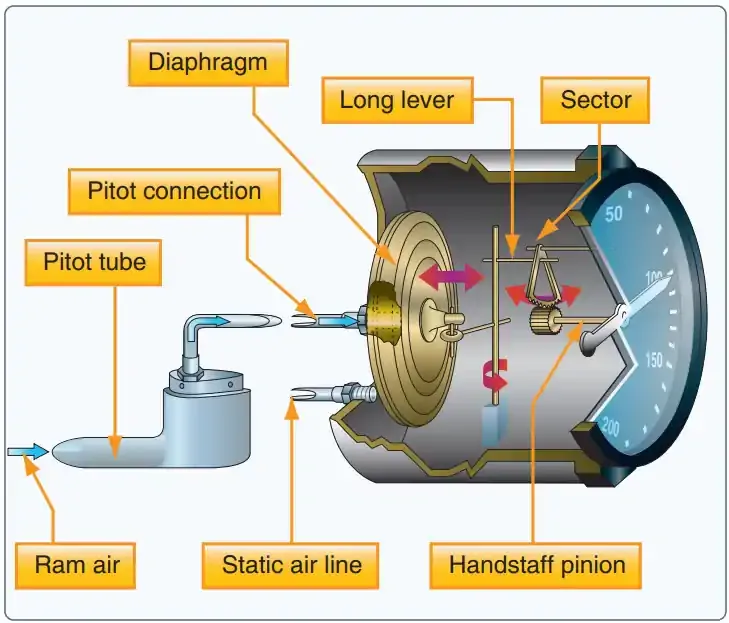
Indicated Airspeed is the speed shown on the aircraft's airspeed indicator, calibrated in knots. It is the direct reading obtained without any adjustments for temperature, air density, or instrument errors. IAS is critical for safe operation because it directly relates to the aerodynamic pressures experienced by the aircraft, and it is primarily used for adherence to speed limitations in controlled airspace and under various flight conditions.
Calibrated Airspeed (CAS)
Calibrated Airspeed is a step up from IAS, adjusted for instrument and position errors. At lower speeds and altitudes, CAS and IAS are almost identical, but discrepancies can arise at higher speeds and different aircraft configurations. CAS is used for more precise navigation and when following specific speed instructions from air traffic control.
Equivalent Airspeed (EAS)
Equivalent Airspeed is Calibrated Airspeed adjusted for compressibility effects, which are significant at higher speeds near or exceeding the speed of sound. EAS is particularly important at high altitudes where the air density is low, and compressibility effects become more pronounced. It is used for aerodynamic considerations in flight testing and to ensure the aircraft stays within safe aerodynamic limits.
True Airspeed (TAS)
True Airspeed is the actual speed of the aircraft relative to the surrounding air mass. It is derived from the Calibrated Airspeed adjusted for altitude and non-standard temperature variations. TAS is crucial for accurate navigation and fuel planning, as it reflects the true rate at which an aircraft covers distance through the air.
Groundspeed (GS)
Groundspeed is the actual speed of the aircraft over the ground. It’s derived from True Airspeed adjusted for wind conditions. Groundspeed is essential for flight planning and navigation, particularly in determining the correct arrival times at destinations and waypoints.
Importance of Different Airspeeds
Each type of airspeed has specific operational purposes:
- IAS is used for maintaining control during takeoff, landing, and maneuvering within structural speed limits.
- CAS provides a more accurate speed measurement for adherence to speed-regulated zones and traffic separation.
- EAS ensures the aircraft adheres to aerodynamic stress limitations, especially in high-speed operations.
- TAS is necessary for navigation and performance calculations over long distances.
- GS helps in accurate time estimations and navigation considering wind effects.
Understanding and correctly interpreting these speeds are foundational skills in pilot training and are crucial for ensuring safe and efficient aircraft operation. For more detailed explanations and examples, resources like Boldmethod and CFI Notebook offer in-depth insights into how these speeds affect flying and how they can be accurately calculated and used during flight.